Showing posts with label alternate history. Show all posts

Saturday, May 5, 2012

World Building Series & Cinco de Mayo

Hello Beardies :)

Many people celebrate the Cinco de Mayo holiday (Mexican, Mexican-American, or not), but many do not know the true reason for its observance--nor do many Americans realize they actually have a reason to celebrate it.  It is because of this that I would like to post an educational post--which will also tie into my World Building Series.

Cinco de Mayo is less about margaritas and more about military conflict.
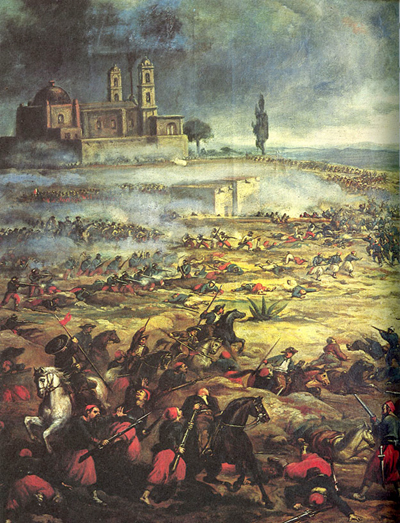
Battle of Puebla
Cinco de Mayo has its roots in the French occupation of Mexico, which took place in the aftermath of the Mexican-American War of 1846-1848, the Mexican Civil War of 1858, and the 1860 Reform Wars. These wars left the Mexican Treasury in ruins and nearly bankrupt.

On July 17, 1861, Mexican President Benito Juárez issued a moratorium in which all foreign debt payments would be suspended for two years.  In response, France, Britain, and Spain sent naval forces to Veracruz to demand reimbursement. Britain and Spain negotiated with Mexico and withdrew, but France, at the time ruled by Napoleon III, decided to use the opportunity to establish a Latin empire in Mexico that would favor French interests, the Second Mexican Empire.

In late 1861, a well-armed French fleet stormed Veracruz, landing a large French force and driving President Benito Juárez and his government into retreat. Moving from Veracruz towards Mexico City, the French army encountered heavy resistance from the Mexicans near Puebla, at the Mexican strongholds of Fort Loreto and Fort Guadalupe.  The French army, led by Napoleon III and 8,000 strong, attacked the much more poorly equipped Mexican army of 4,000. Yet, on May 5, 1862, the Mexicans managed to decisively crush the French army, one which, according to an article in Philadelphia's The Bulletin daily newspaper, was the best army of the time.

At the same time of the French occupation of Mexico, America was fighting its own Civil War, a war in which Napoleon III had a great deal of influence.  What most Americans do not know or realize is that they also owe a lot of gratitude to the Mexican defeat of the French.  It is because of this defeat that Napoleon (who was aiding the Confederacy in hopes the war would divide America, making it an easier target and less of a threat on the French Empire), was unable to deliver much-needed supplies to a struggling Confederacy, which only grew weaker.  The Union was able to defeat the Confederate Army and unite America on account of the Confederacy's weakened state.
{Source: Wikipedia}

Now you know--and knowing is half the battle--but you are probably scratching your head and wondering what any of this has to do with Fantasy, writing, or World Building... right?

Simply this:  Why not create a "holiday" for your "World", one which is celebrated blindly by the world's denizens, and then have one of your characters explain its true origins to another character (or group of characters) as an excuse/outlet to describe the details of an epic battle scene from the past that now has repercussions on current events within the book?

Perhaps it sounds like a stretch to you, but I have an instance in the third book of my Chronicles of Aesiranyn series where another character does exactly that!

Or how about this... what if you were to create a world--an alternate history--in which France won the Battle of Puebla and took control over Mexico?  What if the South won the Civil War because of it? What would the world be like?  What Mexico still be called Mexico, or perhaps some French variation of the word?  Would Napoleon have succeeded in dividing America?

So many other questions arise, each with an answer that provides yet another scenario/possible storyline, and this is just one of many plots along the history of the world!

I am hoping that this post created some inspiration for some notebook scribbles!


Happy Scribbling... er, Scribing,


Wednesday, February 29, 2012

World Building Series: Introduction and Fundamentals

Greetings Readers!

While writing on my current project, Valkyrie, the other day, an idea for a post started to formulate in my mind.

World Building.  

Fantasy and speculative fiction or not, every book (and movie/screenplay) has it.  Even non-fiction has a bit of world building involved.  An author must know the limits and facts about the world in which he/she is writing before he/she can construct a believable, fully-formed story.  If an author's facts have inconsistencies or flaws, he/she can discredit his/her knowledge of the craft, and by doing so, quickly lose readership.  Simply put: if you don't know the world in which your story takes place, how are you supposed to describe it to your readers in its fullest capacity?

I have been pondering at how to go about writing on such an extensive topic--or even how to begin doing so, for that matter.  After much deliberation, I decided that breaking it down into several posts would be the most practical option, not only for my personal choice to put constraints on post lengths, but also to get more detailed and concise, content-related posts for you, my readers.

This first post will focus on the initial steps to world building, intertwined with my own anecdotes of trial & error with my own writing, and will also introduce the next post in this specific series.

Before I ever knew what world building was, I was unknowingly creating my own worlds.  After reading books like The Egypt Game, The Bridge to Terabithia, The Chronicles of Narnia and The Lord of the Rings, I became obsessed with creating worlds of my very own.  I sketched maps galore, created languages (minor undertakings back then), secret codices with which I could write notes to my friends, and planned out entire cities in which to create my stories.

Of course, those worlds failed me; more correctly, I failed them because I didn't know enough about my creations.  Sometimes I would sketch pages and pages of maps with great detail, but I neglected to populate it with creatures and characters that were believable for the setting.  Sometimes, vice versa.  Other times, I forgot to ask myself important questions whose answers would have provided me with a connection between the different aspects of my worlds.  I constantly wrote myself into corners--or worse, circles.  My writing was all jumbled--mismatched additions, not all too dissimilar from the Winchester House--without any coherence whatsoever.  I neglected to make the full blueprint before building the house; but fortunately, with training and practice, I realized the errors and remedied them.

The Winchester House - Santa Clara Valley, California
Most ideas for stories usually develop long before a writer even thinks about world building. Unfortunately, I feel that this leads to weaker stories in the end.  I am saying this from experience because the first few starts at my now-finished manuscript were torturous.  My characters and my world felt disconnected and, to be honest, a bit contrived. In my opinion, it is much easier to build believable characters inside of a defined world than to a build a foreign world around a cluster of characters.

Asking yourself fundamental questions will help guide you in creating the blueprint; and creating a basic blueprint for your world before you go any further will save you a lot of headache.

The first set of questions we will discuss have to do with Earth settings and their variations/possibilities:

1. If this story takes place on Earth, does it occur in the Past?
2. Present?
3. Future?
4. Some alternate version/history of Earth? [for instance, an Earth that has been decimated by a nuclear war or asteroid? A post WWII Earth in which Hitler had won?]

Each answer should and will produce more questions for you to consider, and each answer will also narrow down the genre/category of your manuscript.  Let's take our two examples from above, starting first with a post-asteroid collision.

5. When, where, and how did the collision happen?
6. How did it change the landscape/structure/rotation/orbit/population/technology of the Earth?
7. Were there any alien life forms or microbes on the asteroid?  Or maybe some advanced technology?
8. If yes, how did that change the landscape, environment, or population?  Did it change the genetic makeup of humans/animals/plants? On the negative side, did it bring disease or famine?  On the positive side, did the asteroid's introduction create a superior human/animal/plant?

As you can see, each answer spawns a whole set of additional questions, which then defines the conflicts and plots.  Placing characters within this constructed world is now a breeze.

The questions for our second example might look a little like this...

5. How had Hitler and the Axis forces defeated the Allied?
6. Did Hitler continue his mass genocide?  And if so, how has this affected the population of Earth? Did Hitler succeed in creating an Aryan race? Does everyone speak German?
7. How long after the defeat does the story take place?  Within Hitler's lifetime? Twenty years later?
8. Are there secret Allied forces still hiding out from the Nazi Regime? Are they physically hiding out (in, say, underground caves) or pretending to blend in with society while maintaining their Allied lifestyles in secret?  Are there plans to overthrow the government?

Literally dozens of scenarios with an exponential amount of questions can arise from the first 4 questions above, and that is only dealing with Earth or Alternate Earth settings and plots.  The second part of this post will deal with all other settings.

1.  If the story does not take place on Earth [or any variation], is the setting a known one (i.e., Mars, the Moon, or the Andromeda Galaxy) or some distant or unknown planet/moon/galaxy?  Is it even part of our known universe?
2.  If unknown setting, how was the setting formed?  Evolutionary (like the Big Bang Theory)?  Or Mythologically (created by omnipotent beings)?  Or a combination of the two?
3. How does the setting differ from Earth?  How is it similar?  Landscape/flora/fauna differences and similarities? Does it still have earthly forces (like gravity)?  Does it have unearthly forces, i.e., majick (more on this later)?
4. Is it populated by more than one race/species?  Are they humanoid?  Are all of them intelligent?
5. Are there areas with concentrations of certain races, or do all the races live together?
5. If there is majick, where is it derived from (sun, moon, water, earth, air, blood, artifacts, etc)?  Are all the races majickal?  Only a few?  One?
6. Are the majickal races exalted or suppressed?  Is a majickal race the ruling race?  Does it view the other races as unequal because of its lack of majick?  Or vice versa?

The questions are endless, and so are the answers.  And each answer lends itself to a different aspect of your world--from character races, history, politics (power struggles, classes), mythology (creation myths, deity current involvement and interaction), languages (spoken, written, ancient), majick (source, limitations, how it's produced and used), et cetera.

The list is infinite, and I know I barely touched the surface when it comes to introducing World Building, which kind of brings me to introducing the topic of the next series in this post:  Overdoing it!

I welcome any questions or comments and would be happy to respond to them.

Stay Tuned for the next post in this series,


P.S. If you are here visiting the page and reading this post and are not yet a member, please click the links to the left to sign-up. It's quick and simple.
Related Posts Plugin for WordPress, Blogger...