Wednesday, July 18, 2012

Exciting Announcement!

Hello Beardies,

From The Bearded Scribe's inception in February, I've had a handful of devout followers, all of whom kept me typing and posting away when at times I wondered if my audience would ever be big enough for all the work I was putting into the foundation and constant research for exciting posts on the blog.

One such follower--whom you all have met and whose posts you all have had the opportunity and pleasure in reading--is Ms. Elizabeth Norton.


Since joining the blog as a Guest Scribe--and even before then--Elizabeth has shown a passion for the topics that appear on the blog, going well beyond the call of duty that any Guest Scribe should.  She has offered critiques, edits, and her ideas and opinions on most posts, not to mention her constant encouragement.

It is because of this reason that I am pleased to announce Elizabeth as The Bearded Scribe's Assistant Editor! The position is unpaid, except in gratitude and friendship, but I wanted to give her the acknowledgement she deserves.  Because she deserves to be paid for all that she does, I will be indebted to her even more than I am already.

I hope you all take the time to comment and commend Elizabeth on this title!

Congratulations, Elizabeth! And thank you again for all that you've done and all that you continue to do!  I am so lucky to have you as a friend, and I am so happy to have your passionate insight on The Bearded Scribe Team! :)


Happy Scribing!

Monday, July 16, 2012

Movie Spotlight: Brave

Hello Beardies,

Hang around The Bearded Scribe long enough, and you will inevitably catch a glimpse of Scottish pride amidst its contributors. Elizabeth is a direct descendant of Clan Ross, the first named clan, designated by King Malcolm IV of Scotland in the twelfth century; Sara is also of Scottish descent, and Joshua has a bit of all the British Isles in him from his mother's side.

If genealogical reasons of pride weren't enough, Joshua, Sara, and Elizabeth met when they were all students at Alma College, home of the Scots. (The city of Alma is nicknamed Scotland USA.) The College has its own registered tartan, which both the marching band and the pipe and drum corps wear for every performance; every convocation starts with the bagpipes; the Choir can often be heard in the Chapel (or, on occasion, in secluded churches in Scotland!) singing tunes such as "Loch Lomond" and "Highland Mary;" and at the end of Spring Term, the students must vacate the dorms to make way for the Highland Festival, a huge gathering including traditional Highland music and dance, a nearly-frightening number of men in kilts, and Highland games.

It is because of this Scottish pride that The Bearded Scribe excitedly brings you its second ever Movie Spotlight on Disney/Pixar's latest film, Brave.  And to top it all off, it is the first ever post to appear on the blog with two contributors! (We're sure it won't be the last!)

Plot Summary A born tomboy and expert archer, Merida is not your average girl, but, as her mother often reminds her, she’s a princess, and with that comes expectations. The clans are about to gather, bringing their suitors to compete for Merida’s hand, and of course, Merida wants nothing to do with it—especially after she sees just who these potential suitors are. She devises a way to compete herself so as not to have to get married, but it causes her worst fight yet with her mother and Merida runs away. Deep in the woods, she follows will-o’-the-wisps to a witch’s cottage. The witch gives her a spell to change her fate, but when the spell backfires, trapping her mother in the form of a bear, Merida must use all her wits and skills—princess-like and otherwise—to save both her independence and her family.
The Land  One of the greatest aspects of Brave is the film's unforgettable landscape, beautifully portrayed through superb animation.  The entire "world" built by the film is complete, and the landscape alone is merely one of its facets.  In addition to the lush, green rolling hills, the crags and high cliffs, and the architecture of monuments and buildings, the film includes key elements to the traditional, Celtic culture.  Intricate knotwork is carved on wood and stone throughout—including Merida's bow.  Nary a scene exists without a man in a kilt or some display of tartan (ever wonder what the Scotsmen wear under those kilts... watch this film and you will no longer), a few of its characters adorned in woad paint (a tip of the hat to Braveheart, perhaps?), and fanciful tapestries line many a wall. Many of the Scottish traditions outlined in our intro are beautifully and respectfully reflected in Brave, one of them specifically is that of the Highland Games.  According to tradition, each clan presents its most desirable suitor for the hand of the Princess, and the winner is determined through a test of her choosing. Brave’s focus is not mainly on romance; rather, in a stroke of unconventional plotting, the games serve as an impetus for the main conflict between Merida and her mother, and between Merida and the conventions of her society. Another aspect we loved about Brave is the wonderful music contained in its soundtrack.  As we are both vocalists and lovers of music, this was one aspect, in our humble opinion, the film had no room to get wrong.  They didn't.  The composer of the film's musical score, Patrick Doyle—also the composer of Harry Potter and the Goblet of Fire—used traditional Scottish instruments such as the bagpipes, a solo fiddle, Celtic harps, and the bodhrán, just to name a few. Doyle was quoted as saying, "I employed many classic Scottish dance rhythms such as reels, jigs, and strathspeys, which not only serve the action but keep it authentic." The only issues we found with the world-building of the film were anachronisms.  Given the film was fictionally set in 10th Century Scotland, the use of plaid (15th-16th Century), kilts (18th century); forks (16th century); Shire horse (breed developed in the mid-17th century) and fighting the Romans (1st-5th century) all fit the bill.  Because we love all things Scottish, we happily forgive them.
The Legend
If there is something that must be mentioned, it is the way elements of folklore and mythology are interwoven throughout the entire film. While there is no precedence for the actual legend of the plot, other elements from Celtic lore are used ingeniously to drive home the “fairytale” aspect. From its very start, we are introduced to will-o'-the-wisps—colloquially referred to as "wisps"—which Merida is told (by her mother) are said to lead a person to their fate. The “wisps” vanish when approached, just as the actual lore states; ironically, however, in most Celtic lore a “wisp” (or ignis fatuus) is said to lead travelers away from the safety of the path (into bogs and other treacherous destinations). Continuing with the “fairytale” notes is the sacred henge in which the final showdown takes place. It represents not only the sacred rock formations that speckle the British Isles, such as Stonehenge—which are placed on sacred sites filled with the natural energies from the Earth—but also the smaller-scale formations referred to as “faerie rings.” These sites were said to be portals to the land of the Sidhe, and were to never be entered. Merida's horse, Angus, obeys this superstition by stopping suddenly at its edge, meanwhile throwing Merida into its center. The fact that the wisps appear from this site to lead Merida to witch's cottage is another allusion to the Faefolk they are meant to represent.
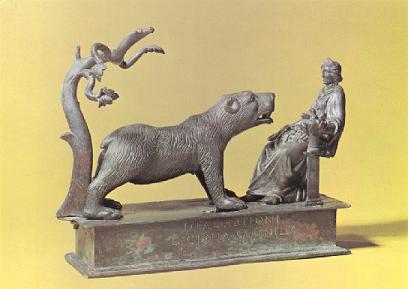
Another mythological element which is prevalent—if not pervasive—is that of the bear. While researching for this post, we discovered a possible connection between Queen Elinor and the Celtic Bear Goddess, Artio, often referred to as “Mother Bear.” We even uncovered an ancient statue of said goddess that appears strikingly similar to one that may or may not have made an appearance in the witch's wood-carving shop. The legends and myths that appear throughout the film and its landscape are like the tapestry in the film; they are tightly woven, never to be torn from one another. The mistakes and stories of the past—however far-fetched and magical they might seem—are there to educate generations of the future. We must take heed and not dismiss them so quickly, which echoes Queen Elinor's line in the movie:
“Legends are lessons, and they ring with truths!"
The Lessons Learned  As firm believers that no woman should need a man to make her complete, we really enjoyed seeing a Disney/Pixar film wherein romance is present without being the main focus of the plot. We’re not anti-love by any means, and both agreed that the romance between the Queen Elinor and King Fergus is sweet.  Love, after all, makes life sweeter, but love comes in more forms than just romance. Merida is a tenth-century girl with a twenty-first century mindset, and her independence and determination is refreshing. She knows she can do better than any of the suitors she is offered, and she’s not willing to compromise or settle—a position we totally support.
Unless you've been living under a menhir somewhere—or trapped under one—you've most likely heard the expression: “Be careful what you wish for.” The main theme of Brave is exactly this, and it is an expression Princess Merida already knows all too well. Despite this, she wishes for her mom to change, and when the Queen is transformed into a bear, Merida must deal with the consequences. Afraid for her mother's life—due to her father's understandable hatred of bears—Merida and the Queen flee the family's castle in search of the witch or the wisps that led her to her fate.  While helping Merida with trying to find a way to reverse the spell, Queen Elinor gains respect for her daughter's strength and wilder side; Merida, too, finds a deeper respect for her mother when faced with the prospect of losing her forever.  Also, they discover that Merida is not the first to wish for a change of fate, and by repairing the mistakes she made, she has the opportunity to correct the wrongdoings of the past.
In Conclusion Given our love affair with all things Scottish, we had high hopes for Brave, and we weren’t disappointed. Add in a strong female lead, stirring soundtrack, and beautiful scenery and animation, and our separate trips to see this film were time well spent. As a bonus, it gave us a chance to truly collaborate for the first time, a practice we hope to keep up in the future!
Rating:
Gus an coinnich sinn a'rithist,
and

Monday, July 9, 2012

World Building Series: Settings -- Part I (Introduction)

Afternoon Beardies!


When I started my blog back in February, I knew right away that I wanted to include a World Building Series to help other writers.  The series is designed as a reference point, to seek help if you have questions, and sort of a guide of "tips" and "techniques" in various areas of the World Building process.
(Of course, I am always open to direct questions from my followers; if you have a question you can always leave it in the comment section of this or any other post.)

I've been putting this area of World Building off for obvious reasons.  It's massive, and it is going to take several posts to cover such an extensive topic.  Other than on my languages, I've spent the most amount of time on this area when the original story idea for The Chronicles of Aesiranyn kept--for the lack of a better word--haunting me.

Lets start with the starting point you should start with as a writer... Maps.

An Aerial View of Elizabeth's Dream Circulatory Desk :)
Even if you are writing an urban fantasy story set in a major city on Earth, your world should have a map.  Of course, if that is the case, your map is already available, and you merely have to pull up Google Maps.  By saving those maps (screen shots) as a quick reference guide, you will save yourself many headaches of wondering what is located on the cross-streets of say... 42nd and 5th in New York City, wherein lies a bibliophile's own fantasy.

For the purposes of this introduction, however, let's assume you are building your own world.

Maps in Fantasy Books:
Having a map is crucial to World Building because it helps you, the writer, view your world so that you may keep facts and settings consistent.  It also provides you with a somewhat haphazard but helpful scale of your world so that you may know the distance between two places (how long does it take to travel from Point A to Point B).  However, if you decide to include a map in your final product, having a realistic and thought-out map--with a humble regard to how geology forms things such as coastlines, mountains, rivers, et cetera--will greatly benefit you.  There have been a few occasions in which I have opened a book and found a map that didn't seem realistic or thoroughly researched, and so, without even a look at the text, I closed the book and placed it back on the shelf.  On that note, however, there have been a couple of books in which I have ONLY glanced at the included map and decided to buy it.

Let's touch on a few of those geological formations for this blog post.

Coastlines:
Coastlines are irregular.  If your coastline looks like a circular or rectangular blob, your doing it wrong. Coastlines are created by the shifting of tectonic plates--plates pulling away from one another resulting in oceanic trenches, which are never clean lines.  Nothing in nature is ever a clean line.  Coastlines are then continually changed by the constant erosion of landmass by the waves, which is completely dependent upon the geological make-up along the coast.  (Softer materials erode quicker, leaving the harder, more resolute material behind).  On the other hand, if your fantasy world is made up of man-made landmasses, then by all means, draw in straight, clean lines.

An excellent place to look at how coastlines appear is an atlas.  Or, in this day's technology, Google Maps.  You can take any island, any coastline of any continent (or, for that matter, just a section of it), or any ocean (or sea, gulf, or bay) as inspiration.  Or, if that doesn't inspire you, maybe its inverse will be appealing to your creative spirit.

Another great place of inspiration for the coastlines of your world can be found in nature--or even those elementally frustrating situations around the house.  Have a water stain on a wall or ceiling? Trace its outline as a start and then embellish.

Mountains:
Like coastlines, mountains are also caused by the shifting of tectonic plates--but their convergence and deformation.  Orogenesis--or the creation of mountains--happens along the lines of tectonic plates, which is the reason for extensive mountain ranges as opposed to singular peaks.  Sometimes the subduction of one plate under the other occurs, but more often the convergence of the tectonic plates pushes both plates upward, causing crumpling on either side.

There are always exceptions to the rule, but taller, rigidly-peaked mountains are usually the youngest, while smooth, rolling peaks signify an older range.  Take the Appalachian Mountains, for example; they are the oldest on Earth--and are one of the most visually appealing mountains because of their gently rolling peaks and valleys.

Take heed when drawing your own mountains.  Get to know your land.  What did it look like in its most primitive stages?  Or is it still in said stage?  Have its plates shifted and moved away from one another creating a drastically different landscape?  Mountains should occur along where the plates collide.

Rivers:
Rivers flow down from higher elevations toward lower elevations.  So, in simple terms, from mountains toward coastlines.  They take the most direct route, so long as there is nothing impeding that route.  In other words, rivers will not often change directions, unless there is, say, another mountain range blocking its route to the coast. I am in no way saying they travel in a clean, straight line (remember that nothing in nature is ever a clean line), just that they their routes are downhill.

Rivers converge; smaller tributaries flow into larger rivers.  Rivers do not split, unless there are sound geological reasons for its divergence, and in this instance, the divergence happens for short distances, eventually re-converging.

If a river flows into another body of water, such as a lake, it will continue.  A lake will empty at the lowest side of the lake, wherever that may be, so pay attention to the altitude in the different areas of your world.

A Word of Advice:
I am sure you all have heard the saying "If you want to be a great writer, then read, read, read," but the same is true for world building.  If you want to create great maps for your world, pick up an atlas.  Look at the intricacies of the coastlines of several different bodies of land.  Study the layouts, paying close attention to the three areas mentioned above.


Another great place to visit for help and questions related to World Building, specifically map creation is The Cartographers Guild, a forum on which you read and even participate in related threads.  


Get Busy Building & Happy Scribing, 


Related Posts Plugin for WordPress, Blogger...